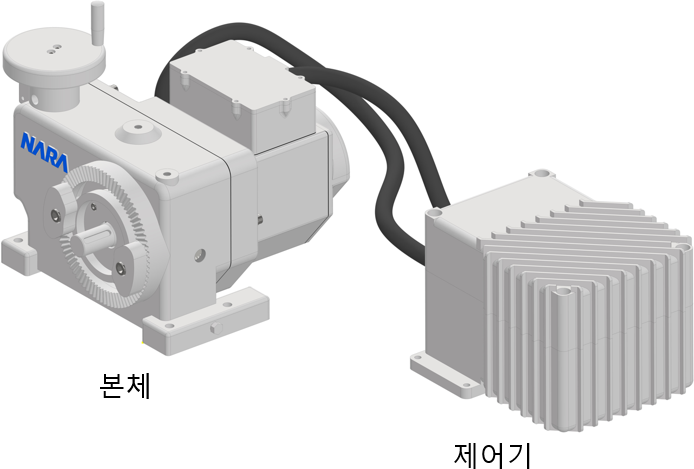
Actuator
MOTION ACTUATOR
Overview
- The Motion Actuator is a device that performs mechanical motion by converting input signals into physical movement.
- Used for various purposes such as air control, boilers, incinerators, combustion burners, pressure control, and valve control.
- Designed with integrated components including motor, gear reducer, limit switch, relay, manual handle, and control box, ensuring high reliability.
Application
- Piping systems connected to pumps,
- Fans,
- Compressors,
- Air handling units, etc.

Features and Components
- Low Backlash
-
- Precisely machined to minimize backlash.
- Excellent Durability
-
- Equipped with ground gears for high driving efficiency.
- Uses highly wear-resistant materials.
- Capable of frequent forward/reverse operation and long-term running.
- Speed Adjustment Function
-
- Servo control system allows adjustable operating speed.
- Automatic and Manual Operation
-
- Manual operation is possible during installation, emergencies, or while the actuator is running.
Operating Principle
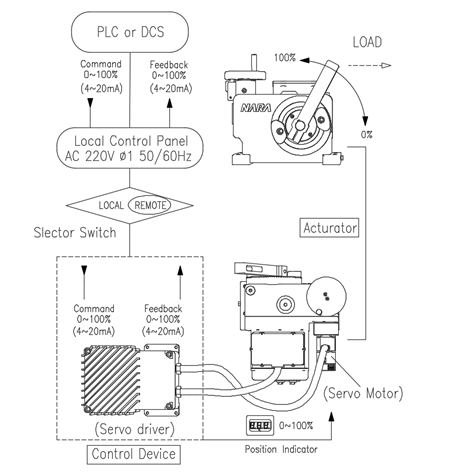
- The Motion Actuator is used to precisely control the flow of a fluid coupling.
- It receives a command signal, moves to the specified position to perform the task, and simultaneously sends a feedback signal to indicate the current position.
- Composed of a servo motor, gear reducer, manual handle, and control system, making management and maintenance easy.
- The servo control system enables dynamic speed control depending on load conditions.
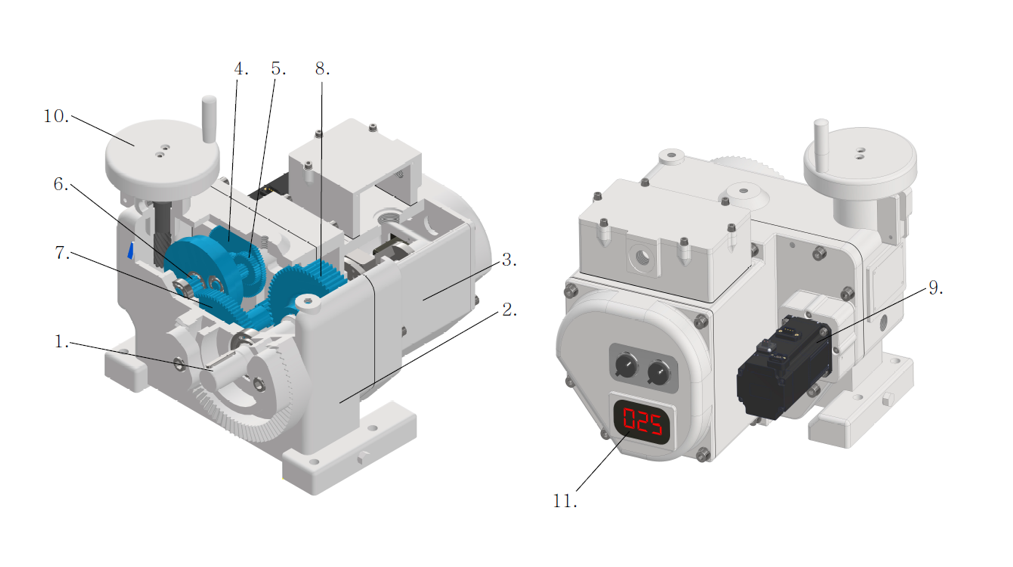
Structure
- 01 Output Shaft
- 02 Housing
- 03 Rear Cover
- 04 1st Gear Set
- 05 2nd Gear Set
- 06 3rd Gear Set
- 07 4th Gear Set
- 08 5th Gear Set
- 09 Servo Motor
- 10 Manual Handle
- 11 Display
Specifications
- Rated Torque: up to 500 Nm
- Operating Speed: 10s ~ 180s / 90°
- Operating Angle: 45° ~ 160°
- Protection Grade: IP65
- Control Signal: 4~20 mA
- Power Supply: 220V AC, 50Hz or 60Hz